
Buyers comparing brush suppliers usually see price lists, not production floors. But where and how a brush is made explains most of what a buyer cares about: consistency between orders, whether custom sizes are truly custom, and why prices differ between “manufacturer” and trader. This post walks through the production steps inside a brush factory, using our own lines as the example.
Step 1: Filament Selection and Preparation
Brushes start with filament: polypropylene and nylon in diameters from 0.15 mm to 3 mm, crimped steel wire, horsehair mixes and synthetic heat-resistant fibre. Filament arrives on spools and is cut or fed by machine to length depending on the brush type. Filament choice is locked at the quotation stage — the specification that guarantees your counter-sample matches your production order.
Step 2: Three Production Routes
Tufted and wafer brushes. Filament is folded double and stapled into pre-drilled holes in a steel ring or block, then locked and trimmed. Wafer brushes for sweepers are built this way — each ring is a stack-ready segment.
Strip brush. Bristle is fed between a folded galvanised or stainless steel channel and a steel backing strip, then stapled continuously. The output is brush in any length, which is why strip brush is the most flexible product in the range: door seals, machine covers, escalator safety strips all come from the same line.
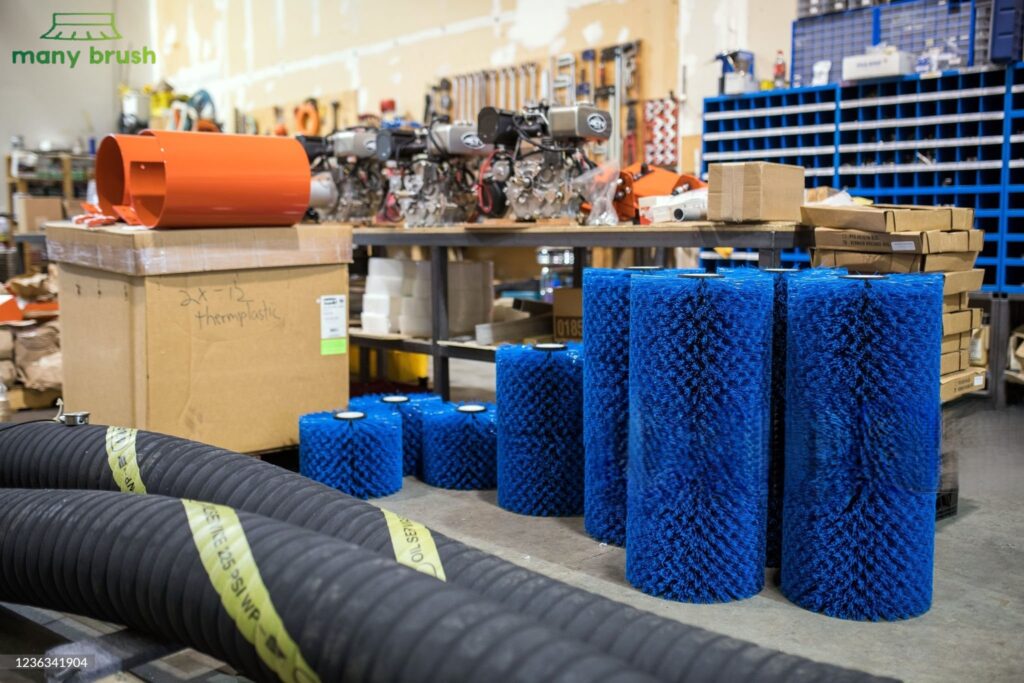
Spiral-wound brushes. Filament is wound helically around a core and bonded or stapled as it winds. Conveyor rollers, fruit-washing cylinders and glass-cleaning brushes come off this line, wound to any length on the same mandrel range.
Step 3: Quality Checks That Actually Matter
Between production and packing, three checks catch most field problems:
- Pull testing — bristle tufts are pulled to verify staple retention, the failure mode behind “shedding” brushes.
- Balance check for rotating brushes — an unbalanced spiral roller vibrates, wears bearings and makes noise; every roller above a size threshold is checked.
- Dimension audit — OD, trim length, channel profile and bore measured against the order, first article and then by batch.
This is the practical content of an ISO 9001-style quality system — not the certificate on the wall, but which measurements are taken and what happens when one fails.
Step 4: What “Custom” Really Means
With over 300 existing moulds and dies, most custom requests — a different wafer diameter, an odd channel length, an unusual fill mix — are produced on existing tooling. True new-tooling jobs (a special ring die, an extruded channel profile) are quoted separately with sample approval. The distinction matters commercially: existing-tooling custom work carries no tooling charge and ships in the standard 15–25 day window.
Why Factory-Direct Changes the Buying Experience
When the seller manufactures the brush, three conversations become possible: fitment engineering (send the worn part, get a counter-sample), specification adjustment (change fill or density before mass production), and consolidation (side brushes, strip brush and spiral rollers in one shipment, one set of documents). None of these work through a trading layer.
See the range: Custom Industrial Brush OEM · Sweeper brushes · Strip brush
