
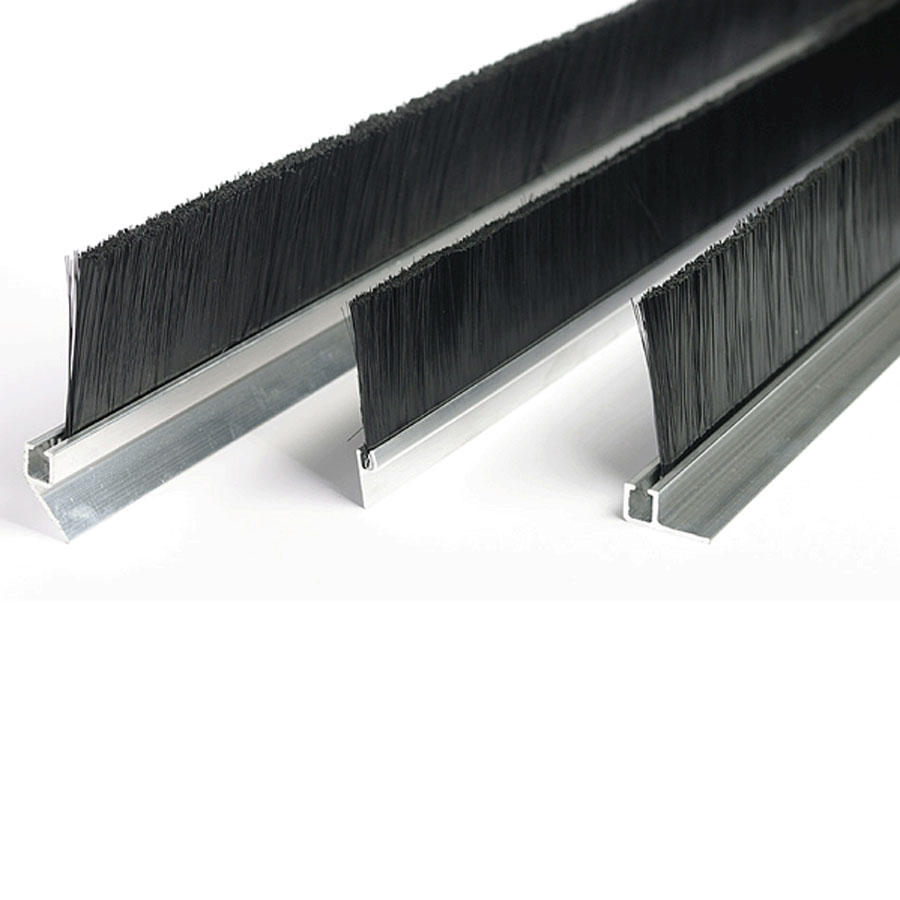
A strip brush door seal looks simple — a steel channel holding a row of bristles — but choosing the wrong one shows up immediately as drafts, dust ingress, crushed bristles or a door that no longer closes cleanly. For door manufacturers and facilities engineers, the specification questions below decide whether the seal lasts six months or six years.
What a Strip Brush Seal Actually Does
Unlike a rubber gasket, a strip brush tolerates surface irregularity. The bristles flex around uneven floors, warped frames and moving parts while still blocking airflow, dust, light and pests. This is why brush seals are standard on sectional overhead doors, cold-store doors, cleanroom swing doors and machine enclosures. In machine guarding applications, brush strips also serve as a soft barrier around moving components — see OSHA‘s guidance on machine guarding for why compliant barriers matter.
Question 1: What Gap Are You Sealing?
Measure the gap between door and frame at its widest point, then add 10–15 mm of bristle overlap. A common mistake is ordering brush length equal to the gap: the bristles then barely touch and the seal leaks from day one. For floor sweeps on overhead doors, the brush should contact the slab with 8–12 mm of compression.
Question 2: Which Channel Profile Fits Your Mounting?
Three channel families cover most doors:
- H-type channel — slides into a track; best for doors you want to service without tools.
- F-type channel — self-adhesive or screw-fixed flat back; the standard choice for straight frame sealing.
- P-type channel — angled profile for corner mounting and curved applications.
Channel material is almost always galvanised or stainless steel. Choose stainless in wet, salty or washdown environments.
Question 3: Which Bristle Material Suits the Environment?
| Environment | Bristle |
| Standard indoor door | Polypropylene |
| Freezer / cold store | Polypropylene (stays flexible below zero) |
| High heat (>100 °C) | Horsehair mix or nylon HT |
| Static-sensitive (electronics) | Conductive synthetic |
| Abrasive / outdoor | Crimped steel wire |
Cold stores deserve a note: rubber seals stiffen and crack at low temperature, while polypropylene bristles stay supple — one reason brush seals dominate in cold-chain logistics.
Question 4: Custom Length or Stock Length?
Standard strip brush ships in stock lengths, but most door projects need continuous runs. Brush strip is manufactured to any length from the same tooling, so ordering exact lengths usually costs nothing extra and removes field cutting. Typical factory MOQ starts around 20–50 pieces depending on profile.
Getting a Quote That Fits
Send three things: gap drawing or dimensions, door environment (temperature, washdown, static), and required total length. A manufacturer that extrudes its own channel can match profile, bristle and backing strip in one production run — which is also the cheapest way to buy.
Spec your seal here: Strip Brush product page
