
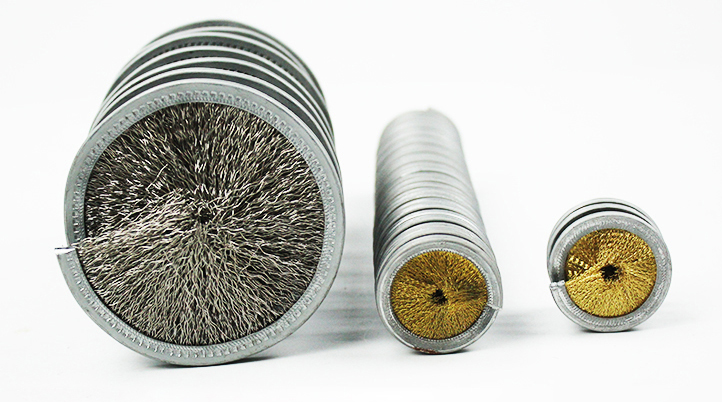
Belt conveyors carry product on the top side and carry residue on the bottom. Spilled grain, crumbs, powders and sticky dust build up on return rollers, pulleys and the belt itself, and a spiral roller brush is the standard rotating solution for scraping it off continuously. For equipment builders and plant maintenance teams, selecting the right spiral brush comes down to four specification decisions.
How a Spiral Brush Cleans
Filaments are wound around a cylindrical core in a helix. As the brush rotates against the belt or product surface, the spiral pattern moves debris sideways while the bristle tips sweep it off — combining scraping and conveying in one motion. The same principle cleans fruit, glass bottles, textiles and solar panels, which is why spiral roller brushes appear in so many industries.
Decision 1: Winding Type — Spiral or Helical Pattern
- Single spiral (open wind) — economical, good for light dry dust and general conveying.
- Dense double spiral — tighter fill for sticky or wet residue.
- Helical from both ends (mirrored) — debris is driven toward the centre or to both edges; used when you want controlled discharge of material.
Match the winding to how the dirt should leave the belt, not just how it looks on the brush.
Decision 2: Fill Material
| Application | Fill |
| Dry powder, grain, crumbs | Polypropylene |
| Wet, sticky, greasy residue | Abrasion-resistant nylon |
| Hot surfaces (>100 °C) | Heat-resistant bristle or wire |
| Mineral scale, baked-on soil | Crimped stainless steel wire |
| Food contact zones | FDA-compliant PP or nylon, stainless core |
Food equipment builders should confirm fill and core material compliance early — equipment that touches food falls under FSMA sanitary transport and food safety requirements in the US market.
Decision 3: Core and Drive
Spiral brushes run on shafts or on their own journal. Specify:
- Core diameter — must match your shaft or bearing arrangement.
- Core material — stainless for food and washdown; galvanised steel elsewhere.
- Brush length — belt width plus allowance; continuous length is produced to order.
Decision 4: Replaceability
The smartest design separates the wearable brush from the metal core: a spiral brush sleeve that slides onto a reusable core shaft. When the bristles wear down, you replace the sleeve, not the whole roller. Over a conveyor’s life this is the largest single saving — the core lasts years, the sleeve costs a fraction.
Sizing Checklist for Suppliers
When requesting a quote, send: brush OD, core/shaft diameter, brush length, fill material, winding pattern, and the machine it mounts on. A manufacturer with in-house winding can produce any length without new tooling, typically in 15–20 days, with sample rollers available for trial fitting.
Full specs: Spiral Roller Brush product page · Spiral brushes range
