
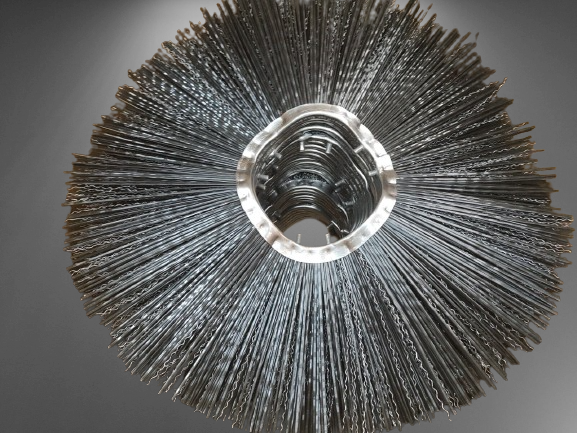
Most sweeper decks use both: wafer segments build the main broom core, and strip brushes seal the housing or act as gutter drags. But buyers replacing a whole broom system often face the question — should the core be built from wafers, or is a one-piece brush with strip-style wipers the better setup? The honest answer: they solve different problems. Here is the comparison that matters for cost and performance.
What a Wafer Brush System Is
Individual segments — flat or convoluted rings of poly or wire filament in a galvanised steel ring — stack along a wafer rack to form the full-width main broom. One or two pins key each segment to the rack.
Advantages:
- Replace only worn sections, not the whole broom. Centre segments wear fastest; with wafers you swap three segments, not a 2-metre brush.
- Mix filament types along the same core: wire in the middle for compacted dirt, poly at the edges for surface protection.
- Lower shipping cost — segments nest inside each other.
Trade-offs: more parts to stock, and installation takes 20–40 minutes versus minutes for a one-piece brush.
What Strip Brushes Do on a Sweeper
A strip brush — filament set in a steel channel — appears in three sweeper roles: dust skirt around the suction hood, drag shoe wiper behind the main broom, and sealing strips that stop fines escaping the housing. Here strip brushes are not an alternative to wafers; they are a complement. A leaking skirt defeats an expensive vacuum fan, and a strip brush costs a fraction of the dust it stops.
The Cost-per-Hour Comparison
For the main broom core, compare on three numbers:
| Factor | Wafer core | One-piece core |
| Initial cost | Lower per brush | Lower per installation |
| Replacement scope | Worn segments only | Whole brush |
| Inventory needed | Spare segments | Full spare brush |
| Downtime per change | 20–40 min | 5–10 min |
Municipal fleets running daily routes generally favour wafers: the ability to carry a box of segments instead of a rack of full brooms wins over a season. Rental and low-hour machines often run one-piece cores for simplicity.
Filament Choice Applies to Both
Polypropylene, crimped steel and poly/steel combos behave identically whether wound into a wafer ring or a one-piece brush. Poly protects surfaces, steel lasts two to three times longer on abrasive debris, and combo is the default municipal specification.
Practical Buying Advice
Buy wafers and strips from the same manufacturer when possible — ring thickness, filament diameter and channel profile then match across the deck, and the whole wear list ships in one order with one set of documents. Counter-samples confirm fit before you commit to volume.
Compare in detail: Sweeper Wafer Brush · Strip Brush
